
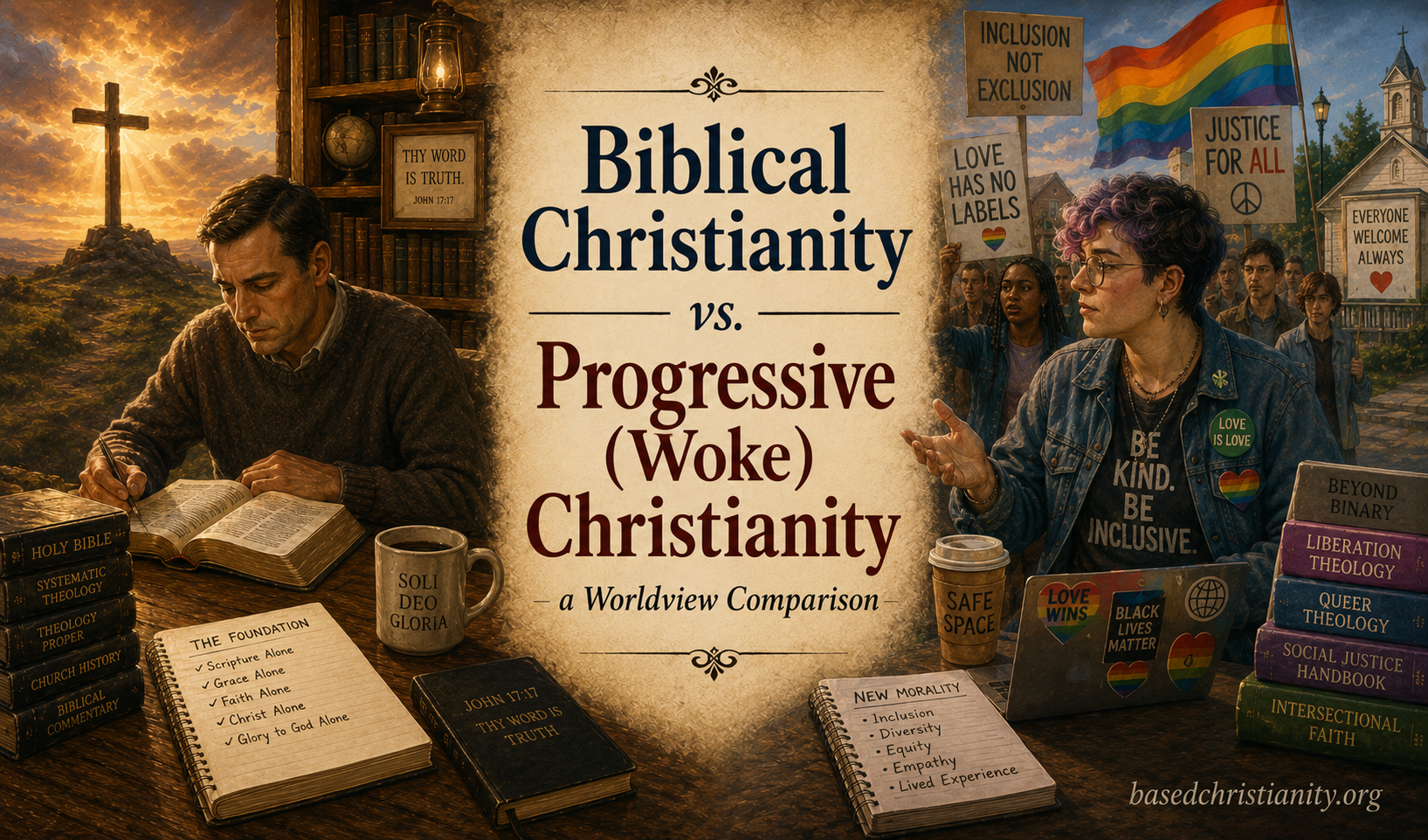
In recent decades, a widening gap has developed between two streams of thought within the church: what is often called progressive or woke Christianity, and the enduring, historical faith of biblical Christianity. While these two systems share certain terminology—grace, justice, love, and gospel—they diverge dramatically in theology, ethics, and authority. This post examines their differences through the Christian lens, identifying the fundamental tenets of progressive Christianity, comparing them to Scripture, and highlighting why these differences matter for the health and witness of the Church.
What Is Progressive Christianity?
Progressive Christianity is a movement that seeks to reinterpret traditional Christian doctrines in light of contemporary cultural values, particularly surrounding issues of race, gender, sexuality, and social justice. It tends to emphasize inclusion, personal experience, and activism over doctrine, repentance, and evangelism.
Core principles of progressive Christianity typically include:
- Subjective Truth and Moral Relativism – Emphasis on “your truth” and “my truth,” rather than the truth rooted in God’s Word.
- Redefinition of Sin – Sin is often seen as systemic injustice (e.g., racism, patriarchy, capitalism), rather than personal rebellion against a holy God.
- Universalism or Inclusivism – The idea that all people are ultimately saved or that salvation comes through many paths.
- Affirmation of LGBTQ+ Identities and Same-Sex Marriage – Departing from biblical teachings on sexuality and gender.
- Experiential and Emotion-Based Theology – Personal experience often trumps the authority of Scripture.
- Political Activism as Kingdom Work – Promotes left-wing political causes as inherent to Christian discipleship.
- Skepticism of Miracles and the Supernatural – Often denies the bodily resurrection of Christ or the inerrancy of Scripture.
Prominent Voices and Institutions
Progressive Christianity is not merely a theological abstraction—it is rooted in real institutions, leaders, and denominations.
Denominations commonly associated with progressive Christianity:
- United Church of Christ (UCC)
- Episcopal Church (TEC)
- Presbyterian Church – USA (PCUSA)
- Evangelical Lutheran Church in America (ELCA)
- United Methodist Church (UMC)
- American Baptist Churches USA (certain regional bodies)
- Christian Church – Disciples of Christ (DOC)
- Church of the Brethren (COB)
- Mennonite Church – USA (MCUSA)
Key organizations include:
- Sojourners – led by Jim Wallis, focuses on left-leaning social justice advocacy.
- Faith in Public Life – advances causes like LGBTQ+ rights, immigration reform, and climate activism.
- Red Letter Christians – founded by Tony Campolo and Shane Claiborne, emphasizing the teachings of Jesus (the “red letters”) as ethical guides.
- Progressive Christian Alliance – loosely organized ecumenical group focusing on inclusion and justice.
- More Light Presbyterians and Reconciling Ministries Network – promote full LGBTQ+ inclusion in their respective denominations.
Biblical Christianity: A Contrast
By contrast, biblical Christianity stands upon the infallibility and sufficiency of Scripture. It understands God as sovereign, man as fallen, Christ as the only way of salvation, and truth as absolute.
Key convictions include:
- The Authority of Scripture – God’s Word is inspired, inerrant, and sufficient for faith and practice (2 Timothy 3:16–17).
- Objective Moral Standards – God defines good and evil; His moral law is not fluid (Isaiah 5:20).
- Salvation by Grace through Faith in Christ Alone – Not through works or activism, but by trusting in the atoning death and resurrection of Jesus (Ephesians 2:8–9).
- Sin as Rebellion Against God – Sin is not just social dysfunction; it is cosmic treason (Romans 3:23).
- Christ-Centered Justice – True justice begins with regeneration and is informed by God’s character, not secular ideologies.
- Evangelism and Discipleship – The Great Commission is central, not optional (Matthew 28:18–20).
How Biblical Christianity Critiques Progressive Christianity
Biblical Christians offer several serious critiques of progressive theology:
- It Undermines Scripture – By denying biblical authority or cherry-picking verses, progressive Christianity opens the door to endless reinterpretation and doctrinal confusion.
- It Redefines the Gospel – The biblical gospel is about rescue from sin and reconciliation with God, not political liberation or affirmation of self.
- It Promotes a Works-Based Identity – Progressive Christianity often elevates activism above faith in Christ, leading to a pseudo-gospel of “justice” without justification.
- It Distorts Love – Biblical love warns of sin and calls people to repentance (1 Corinthians 13:6). Progressive love, by contrast, often celebrates sin under the banner of inclusion.
- It Embraces Worldliness – Rather than being set apart from the world (John 17:14–17), progressive Christians often mirror secular values to gain cultural approval.
How Progressive Christianity Critiques Biblical Christianity
Progressive Christians, in turn, criticize traditional believers for being:
- Rigid or Legalistic – They claim that biblical Christians are too rule-based and not sufficiently open to nuance or compassion.
- Exclusive and Intolerant – The belief in one way to God (through Jesus) is seen as arrogant or bigoted.
- Patriarchal and Repressive – Biblical gender roles and sexual ethics are viewed as outdated and oppressive.
- Political or Nationalistic – Progressive Christians often equate biblical patriotism or civic engagement with idolatry or Christian nationalism.
- Unloving – The call to repentance is often misunderstood as hate speech, especially in conversations about sexuality or gender.
Biblical Christianity’s Counter-Critiques
In response to progressive criticisms, biblical Christianity offers the following clarifications:
- Truth Is Not Hate – Warning someone about sin and judgment is the most loving thing a Christian can do (Galatians 6:1; James 5:20).
- Love Must Be Rooted in Truth – Biblical love cannot affirm what God calls sin (Romans 1:18–32).
- Scripture Interprets Culture, Not Vice Versa – The Church must be salt and light, not a mirror reflecting worldly values (Matthew 5:13–16).
- God’s Standards Are for Human Flourishing – God’s design for marriage, family, and justice is not oppressive but life-giving.
- Christ Alone Saves – Cultural relevance cannot replace the central message of the cross (1 Corinthians 1:18–25).
Why It Matters: The Danger of Progressive Christianity
Progressive Christianity is not simply an alternate flavor of the same faith—it is, in many ways, an entirely different religion masquerading in Christian language. Its gospel is horizontal, not vertical. Its hope is in man, not in God. Its ethic is determined by culture, not by Scripture.
Christians must be discerning, for progressive Christianity:
- Leads People Away from Christ – A gospel without sin and judgment cannot save.
- Undermines the Church’s Witness – When Christians echo the world, they have nothing unique to offer it.
- Replaces Discipleship with Activism – Trading repentance for protest, progressive Christianity majors in virtue signaling but often lacks holiness.
- Fails to Confront the Heart – By externalizing sin into systems only, it ignores the real problem: the human heart (Jeremiah 17:9).
Conclusion: Stand Firm in the Truth
The Church in every generation faces the temptation to conform to the spirit of the age. Today, that spirit is dressed in the garments of inclusion, tolerance, and progress—but it leads to spiritual ruin. Scripture warns that in the last days, many will have “a form of godliness, but denying its power” (2 Timothy 3:5).
Christians must therefore return to the Scriptures, submit to God’s Word, and hold fast to “the faith once for all delivered to the saints” (Jude 3). The call is not to be “relevant” but to be faithful. In doing so, we show the world not a gospel made in its own image—but the gospel of Jesus Christ, who saves sinners, transforms hearts, and establishes truth that will outlast every cultural trend.
S.D.G.,
Robert Sparkman
rob@basedchristianity.org
RELATED CONTENT
Concerning the Related Content section, I encourage everyone to evaluate the content carefully.
I will continue to add videos and other items to the Related Content section as opportunities present themselves.If I have listed the content, I think it is worthwhile viewing to educate yourself on the topic, but it may contain some opinions I don’t agree with.
Feel free to offer your comments below. Respectful comments without expletives and personal attacks will be posted and I will respond to them.
Comments are closed after sixty days due to spamming issues from internet bots.
You can always send me an email at rob@basedchristianity.org if you want to comment on something afterwards, though.
If you have evidence that I am wrong about a material statement of fact, provide the evidence and I will gladly review it and make revisions if merited.
Obviously, there are some assertions that are matters of opinion that I will not change, but I always strive to be truthful. We are all capable of mistakes and misunderstandings on occasion, though.
Regarding depictions of Jesus, images accompanying the article may contain depictions of Jesus.
I realize that some fellow Christians, particularly some conservative Presbyterians, consider these images to be a form of idolatry. I do not agree with their opinion on this matter. The Second Commandment forbids worship of idols. These images are for illustrative purposes and do not represent a form of worship.
I recommend these Youtube channels for good content on Christian matters: Founders Ministries, Ligonier Ministries, Grace to You, G3 Ministries, and Truth for Life. RC Sproul, Voddie Baucham, Alistair Begg, Kevin DeYoung, Albert Mohler, Tom Ascol and John MacArthur are well-known, trustworthy pastors and teachers with content across multiple forums.
Albert Mohler, Francis Schaeffer, Allie Beth Stuckey and Nancy Pearcey have some valuable materials related to cultural matters, as well.