
Many modern Christians have quietly absorbed the idea that faithfulness requires perpetual softness.
The Christian is expected to remain calm while being mocked, endlessly patient while being slandered, and permanently gentle even when confronting destructive falsehood.
In many churches, moral courage has been replaced with therapeutic niceness. The result is a style of Christian engagement that is often polite, harmless, and entirely forgettable.
To be clear, Christianity certainly commands humility, kindness, patience, and self-control.
Scripture condemns sinful rage, vulgarity, cruelty, and malicious speech.
Yet many believers have moved beyond biblical gentleness into something closer to moral timidity. They seem afraid to sound forceful, afraid to embarrass false teachers, afraid to call absurd ideas absurd, and afraid to use memorable rhetoric lest someone accuse them of being “unloving.”
The Bible itself does not speak this way.
Scripture contains sharp rebukes, satire, irony, ridicule, prophetic denunciation, and public exposure of evil.
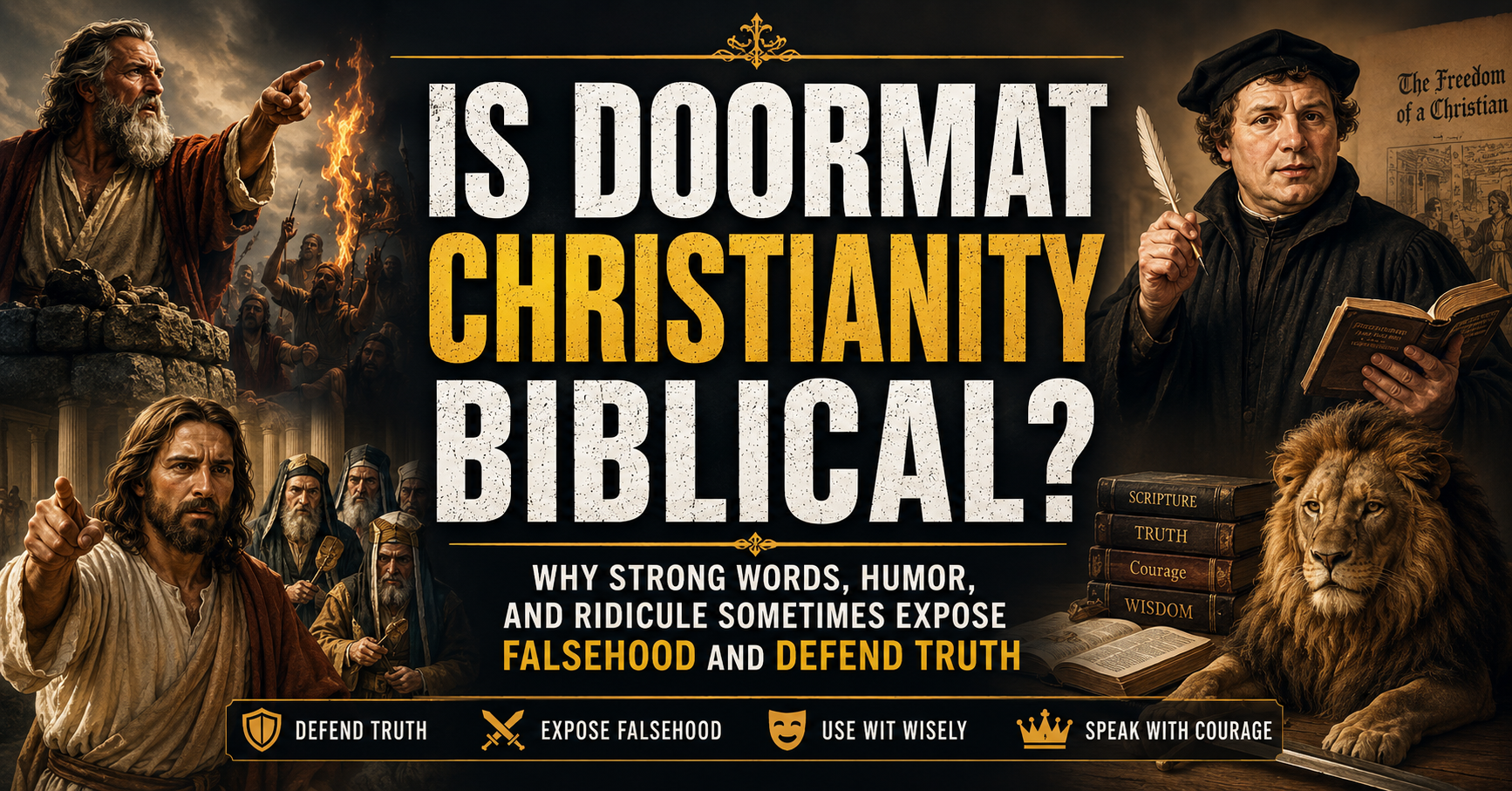
Elijah mocked the prophets of Baal. Isaiah ridiculed idol worship. Jesus publicly humiliated hypocrites. Paul sometimes used language so biting that modern church public relations departments would panic if they heard it from a pulpit today.
The issue is not whether Christians may become cruel or fleshly. They may not.
The issue is whether Christians are required to behave like rhetorical doormats while confronting militant unbelief, ideological manipulation, or spiritual deception.
Biblically speaking, the answer is no.
In fact, there are times when strong words are not merely permissible, but necessary.
What Does “Obstreperous” Mean?
One useful word for understanding certain apologetic encounters is “obstreperous.”
The word refers to someone who is noisily defiant, aggressively argumentative, disruptive, belligerent, and combative.
An obstreperous person is not merely someone who disagrees. He is someone who seeks domination through hostility, intimidation, mockery, emotional manipulation, or endless disruption.
The Bible recognizes this type of person clearly. Proverbs repeatedly warns about scoffers, mockers, fools, and quarrelsome men. These are not humble seekers honestly wrestling with truth. They are often people who enjoy conflict itself and resent moral authority.
Modern Christians sometimes behave as though every opponent is a sincere intellectual pilgrim waiting patiently for a calm explanation.
Reality is more complicated. Some people genuinely are confused and deserve patient instruction. Others are ideological agitators and combatants who use emotional pressure and social intimidation as weapons.
Jesus Himself responded differently to different people. He was gentle with the broken and humble. He was patient with the confused. But He was openly confrontational toward arrogant hypocrites who burdened others while rejecting truth themselves.
Christians are commanded to love their enemies, but love does not require pretending that obstreperous behavior is noble, intelligent, or morally serious.
Christianity Is Not “Doormat Christianity”
“Doormat Christianity” is the belief that Christians must never sound sharp, confrontational, forceful, or publicly embarrassing toward falsehood.
It assumes that faithfulness requires perpetual softness regardless of context.
This idea is not biblical.
The confusion often begins with the biblical concept of meekness.
In modern culture, meekness is frequently interpreted as weakness, passivity, or emotional fragility.
Biblically, however, meekness means controlled strength. A meek man is not incapable of forceful action. Rather, he possesses strength under moral restraint.
Jesus described Himself as “gentle and lowly in heart” (Matthew 11:29, ESV), yet this same Christ drove money changers from the temple, rebuked corrupt religious leaders publicly, and called them “whitewashed tombs” and a “brood of vipers.”
That is not weakness. It is moral authority.
Modern Western culture often treats niceness as the highest virtue. Christians are expected to be endlessly accommodating while militant secular activists, ideological radicals, and hostile commentators are permitted aggressive rhetoric without similar criticism.
This creates an asymmetrical moral environment in which believers are expected to remain perpetually agreeable even while their convictions are mocked, distorted, or attacked.
Unfortunately, many churches have internalized this pressure. The result is a sanitized form of Christianity that fears disapproval more than compromise.
Elijah and the Prophets of Baal
Perhaps the clearest biblical example of righteous ridicule appears in 1 Kings 18 during Elijah’s confrontation with the prophets of Baal on Mount Carmel.
The situation was not a calm academic seminar. Israel had descended into widespread idolatry under Ahab and Jezebel. The prophets of Baal claimed spiritual authority while leading the nation into rebellion against the true God.
Elijah proposed a public test. The prophets of Baal would call upon their god to send fire upon a sacrifice. Elijah would call upon the Lord. The true God would answer by fire.
The prophets of Baal cried out for hours with no response. Then Elijah began mocking them:
“Cry aloud, for he is a god. Either he is musing, or he is relieving himself, or he is on a journey, or perhaps he is asleep and must be awakened” (1 Kings 18:27, ESV).
Modern readers often sanitize this moment, but Elijah’s language was intentionally humiliating. He publicly ridiculed the impotence of Baal and exposed the absurdity of idol worship before the watching nation.
Why?
Because false religion deserved exposure.
Elijah was not engaging in immature cruelty for personal amusement. He was destroying the illusion of Baal’s legitimacy. His mockery shattered the aura of spiritual prestige surrounding these false prophets.
This matters because many destructive ideologies survive primarily through intimidation and social pressure. People fear challenging them openly because they appear culturally powerful. Satire and ridicule can puncture that illusion instantly.
There are moments when detached politeness unintentionally grants falsehood more dignity than it deserves.
Jesus and the Use of Sharp Rebuke
Many modern Christians imagine Jesus speaking in permanently soft therapeutic language. The Gospels present a far more complex picture.
Christ certainly showed extraordinary compassion toward sinners, the weak, and the repentant. Yet He also employed devastating rhetorical force against hypocritical religious leaders.
He called the Pharisees “blind guides,” “whitewashed tombs,” and a “brood of vipers.” He accused them of straining out gnats while swallowing camels. He publicly exposed their hypocrisy before crowds.
These were not accidental slips in tone.
Jesus understood that sharp rhetoric can reveal truth vividly. His language forced listeners to see corruption clearly rather than hiding it beneath respectable religious appearances. He expected his followers to do likewise.
You are the salt of the earth, but if salt has lost its taste, how shall its saltiness be restored? It is no longer good for anything except to be thrown out and trampled under people’s feet.
— Matthew 5:13
Even Christ’s irony could be cutting. When confronting legalistic hypocrisy, He frequently turned accusations back upon His opponents in ways that exposed their inconsistency publicly.
Importantly, Jesus did not respond identically in every situation. He spoke gently to the humble woman at the well. He answered Pilate with measured restraint. He rebuked Peter sharply when necessary. He confronted religious frauds with public severity.
Biblical wisdom recognizes that different situations and different people require different rhetorical approaches.
Paul, the Prophets, and the Ridicule of Folly
The Apostle Paul is often remembered primarily for careful theological reasoning, but his letters also contain remarkably forceful language.
In Galatians, confronting teachers corrupting the Gospel, Paul wrote: “I wish those who unsettle you would emasculate themselves!” (Galatians 5:12, ESV). Modern readers frequently recoil at the bluntness of that statement, yet Paul considered doctrinal corruption spiritually dangerous enough to warrant severe rhetoric.
In Ephesians 5:11–13, Paul commands Christians not merely to avoid participating in evil, but to expose the “unfruitful works of darkness” openly.
The Old Testament prophets likewise used satire and ridicule repeatedly. Isaiah mocked idol makers who cut down a tree, use half the wood for firewood, and then worship the remaining carved object as a god. The point was not merely intellectual refutation. The point was exposure of absurdity.
Falsehood sometimes deserves to be shown as ridiculous because it is ridiculous.
This is one reason memorable rhetoric matters. A dry academic response may technically answer an error while leaving its emotional prestige intact. Satire and irony often accomplish something different: they puncture inflated authority and reveal foolishness plainly.
Chesterton understood this well. So did many Reformers. So did anti-totalitarian dissidents throughout history. Humor can destabilize ideological intimidation in ways formal argument alone sometimes cannot.
Martin Luther and the Power of Memorable Speech
Martin Luther understood the power of vivid rhetoric better than most modern Christians.
Luther’s writing was blunt, earthy, humorous, confrontational, and unforgettable. He mocked corrupt indulgence sellers, ridiculed theological absurdities, and publicly embarrassed religious authorities he believed were deceiving the people.
Part of Luther’s effectiveness came from his refusal to sound sterile. He did not write like a cautious corporate spokesman trying to offend nobody. He wrote like a man convinced eternal truths were at stake.
Luther believed false authority often depends upon intimidation and inflated prestige. Humor can shatter that prestige rapidly.
He frequently used earthy humor and biting wit to expose corruption. At times he undoubtedly crossed into excess. Christians should not imitate every sharp phrase Luther ever uttered. Yet modern evangelicalism may have overcorrected so severely that many believers now fear any memorable forcefulness whatsoever.
The result is apologetics that sounds emotionally managed, sanitized, and forgettable.
Luther remains memorable partly because he refused rhetorical cowardice.
The Value of Humor, Irony, and Sarcasm
Humor is powerful because it exposes weakness unexpectedly. Satire can accomplish in moments what lengthy argument sometimes cannot.
This does not mean Christians should become comedians who trivialize everything. Nor does it mean believers should cultivate a habit of mockery. Scripture warns against sinful speech, crude joking, and reckless words.
Yet humor, irony, and sarcasm can serve legitimate moral purposes.
They can:
- expose hypocrisy,
- puncture arrogance,
- reveal contradiction,
- destroy false prestige,
- and make truth memorable.
Some modern ideologies survive because people fear challenging them openly. Their authority depends partly upon emotional intimidation. Once people begin laughing at their contradictions, the illusion of invincibility weakens dramatically.
Elijah understood this. Isaiah understood this. Luther understood this.
Even ordinary human experience confirms it. People rarely remember carefully balanced bureaucratic language. They remember vivid confrontation. They remember moments when someone courageously exposed absurdity plainly.
This partly explains why many contemporary apologetic exchanges fail to leave lasting impressions. Christians sometimes sound so cautious and emotionally restrained that their opponents appear more confident than they are.
There are times when believers should say plainly that certain ideas are foolish, irrational, destructive, or morally incoherent.
Doing so is not inherently unloving.
The Failure of Sanitized Apologetics
Much modern Christian engagement sounds strangely corporate. It is filled with disclaimers, emotional hedging, and careful attempts to avoid offense at all costs.
Ironically, this often weakens persuasion.
People instinctively recognize when someone is afraid to speak plainly. Excessive rhetorical caution can unintentionally communicate uncertainty or lack of conviction.
Meanwhile, many secular activists, commentators, and ideologues employ ridicule aggressively and unapologetically. Christians are expected to absorb mockery endlessly while responding only with carefully moderated softness.
This imbalance creates problems.
To be clear, believers should not imitate the rage, vulgarity, or cruelty that often characterize modern public discourse. But neither should they pretend that moral courage requires perpetual passivity.
There is a major difference between sinful hostility and forceful clarity.
A Christian may calmly but firmly state that an ideology is irrational. He may expose contradictions publicly. He may employ irony to reveal absurdity. He may ridicule destructive falsehood in appropriate circumstances without abandoning Christian ethics.
In fact, refusing ever to use rhetorical force may sometimes communicate that Christianity itself lacks confidence.
The Moral Limits of Strong Rhetoric
None of this means Christians are free to indulge fleshly anger or personal malice.
Scripture repeatedly commands self-control. Believers must avoid corrupt speech, uncontrolled rage, slander, and cruelty. Strong rhetoric becomes sinful when it flows primarily from pride, hatred, vanity, or the desire to humiliate for personal gratification.
The purpose of forceful rhetoric should be truth, not ego.
This distinction matters greatly.
Biblical satire is usually directed toward exposing evil, hypocrisy, false worship, or destructive deception. It is not random cruelty. Elijah mocked Baal because Baal worship was spiritually destructive. Jesus rebuked hypocrites because they were misleading people spiritually.
Christians should therefore use strong rhetoric carefully and purposefully.
Several principles are helpful:
First, stronger rhetoric is often more appropriate against public deception than private confusion.
Second, believers should distinguish between the teachable and the obstreperous.
Third, memorable forcefulness should remain proportionate rather than constant.
Fourth, Christians should avoid vulgar degradation even while speaking boldly.
Finally, believers should examine their motives honestly. Some people enjoy combativeness for its own sake. That is spiritually dangerous.
Practical Application for Christian Engagement
Modern Christians need courage, clarity, and discernment.
Not every conversation requires sharpness. The confused, wounded, or curious often need patient explanation rather than confrontation. Wisdom requires understanding context.
But there are also situations where stronger rhetoric becomes appropriate:
- public deception,
- militant dishonesty,
- ideological coercion,
- manipulative propaganda,
- and aggressive attacks upon truth.
Online discourse especially requires careful judgment. Many people become addicted to outrage and performative hostility. Christians should resist that temptation completely.
At the same time, believers should not become so terrified of criticism that they lose all rhetorical force.
A memorable witness often requires courage.
The prophets were memorable. Elijah was memorable. Luther was memorable. Their words endured partly because they spoke with vivid moral confidence rather than timid caution.
The modern church does not need more vulgarity or rage. It does not need Christians behaving like internet trolls. But it also does not need another generation trained to believe that holiness requires rhetorical surrender.
Conclusion — Neither Cowardice Nor Carnality
Biblical Christianity rejects both sinful aggression and cowardly passivity.
Christians are called to love their enemies, control their speech, and avoid fleshly hatred. Yet Scripture also demonstrates repeatedly that forceful rhetoric, satire, irony, ridicule, and public rebuke can serve righteous purposes when directed against falsehood and corruption.
Elijah mocked the prophets of Baal because their claims were false and absurd. Jesus publicly exposed hypocrites because their influence was destructive. Paul used severe language when the Gospel itself was endangered. Luther employed humor and ridicule because he believed false authority needed public exposure.
Modern Christians sometimes forget this dimension of biblical witness. In trying to avoid cruelty, they drift into timidity. In trying to appear loving, they become rhetorically worthless. In trying never to offend, they sometimes grant destructive ideologies a dignity they do not deserve.
Truth occasionally requires sharp edges.
The goal is not cruelty. The goal is clarity. Some lies must not merely be answered politely. They must be exposed as foolish. Some ideological intimidation must not merely be endured quietly. It must be punctured publicly.
Memorable Christian witness requires more than niceness. It requires courage strong enough to risk disapproval while remaining governed by truth, self-control, and holiness.
S.D.G.,
Robert Sparkman
rob@basedchristianity.org
RELATED CONTENT
Pastor Voddie Baucham discusses the modern church’s sissified Jesus. This view of Jesus affects the behavior of modern-day Christians, especially those who are influenced by the Progressive (woke) church. Voddie Baucham is excellent.
This is an Amazon link to the book, The Jesus You Can’t Ignore (John MacArthur), which reflects a similar theme as this article .
Concerning the Related Content section, I encourage everyone to evaluate the content carefully.
I will continue to add videos and other items to the Related Content section as opportunities present themselves.If I have listed the content, I think it is worthwhile viewing to educate yourself on the topic, but it may contain some opinions I don’t agree with.
Feel free to offer your comments below. Respectful comments without expletives and personal attacks will be posted and I will respond to them.
Comments are closed after sixty days due to spamming issues from internet bots.
You can always send me an email at rob@basedchristianity.org if you want to comment on something afterwards, though.
If you have evidence that I am wrong about a material statement of fact, provide the evidence and I will gladly review it and make revisions if merited.
Obviously, there are some assertions that are matters of opinion that I will not change, but I always strive to be truthful. We are all capable of mistakes and misunderstandings on occasion, though.
Regarding depictions of Jesus, images accompanying the article may contain depictions of Jesus.
I realize that some fellow Christians, particularly some conservative Presbyterians, consider these images to be a form of idolatry. I do not agree with their opinion on this matter. The Second Commandment forbids worship of idols. These images are for illustrative purposes and do not represent a form of worship.
I recommend these Youtube channels for good content on Christian matters: Founders Ministries, Ligonier Ministries, Grace to You, G3 Ministries, and Truth for Life. RC Sproul, Voddie Baucham, Alistair Begg, Kevin DeYoung, Albert Mohler, Tom Ascol and John MacArthur are well-known, trustworthy pastors and teachers with content across multiple forums.
Albert Mohler, Francis Schaeffer, Allie Beth Stuckey and Nancy Pearcey have some valuable materials related to cultural matters, as well.