
Modern technology has given mankind astonishing powers.
Human beings can communicate instantly across continents, replace failing organs, map the human genome, and increasingly manipulate the reproductive process itself.
Yet Christians have long understood that technological ability and moral legitimacy are not the same thing. The question is never merely, “Can we do this?” but rather, “Should we do this?”
That distinction becomes especially important when discussing same-sex surrogacy.
The modern world often treats reproduction primarily as a matter of adult desire and personal fulfillment. If two adults strongly desire a child and possess the financial means to obtain reproductive services, many assume the moral discussion is effectively over. To object is often portrayed as cruel, intolerant, or hostile to human happiness.
Christians, however, are called to think differently. Scripture consistently teaches that human flourishing is found not in the unlimited fulfillment of desire, but in joyful submission to God’s created order.
As Christian apologist Francis Schaeffer frequently warned, modern societies increasingly treat human autonomy as the highest good, even when human autonomy contradicts God’s design for humanity.
Same-sex surrogacy raises profound moral, theological, social, and child-centered concerns because it intentionally separates procreation from the natural family structure established in creation.
It joins together several controversial technologies and moral claims at once: same-sex parenting, reproductive commodification, embryo manipulation, contractual motherhood, and the fragmentation of biological parenthood.
This article is not written to mock or hate individuals who experience same-sex attraction o long for children.
Christians believe all people bear the image of God and deserve dignity and compassion. Many individuals pursuing surrogacy are motivated by sincere emotional longing and genuine affection. The desire for family and children is deeply human.
Yet sincere desires alone cannot determine moral truth. Scripture repeatedly teaches that human desires themselves must be evaluated by God’s revealed standards. Proverbs 14:12 warns:
There is a way that seems right to a man, but its end is the way to death. (ESV)
The central Christian concern is therefore not whether adults strongly desire children, but whether the methods used honor God, protect children, preserve human dignity, and uphold the created order established by the Creator Himself.
God’s Creation Order and the Pattern of the Family
The Creation of Male and Female
The biblical understanding of family begins not with modern sociology but with creation itself. Genesis presents male and female distinction as intentional, meaningful, and good.
Genesis 1:27 states:
So God created mankind in his own image, in the image of God he created them; male and female he created them. (NIV)
This verse is foundational because it establishes several truths simultaneously. Human beings possess inherent dignity because they bear God’s image.
Yet humanity is intentionally created as male and female. Sexual distinction is not an accidental biological detail or a social invention. It is part of God’s design for humanity itself.
Modern culture increasingly treats men and women as essentially interchangeable. Scripture does not.
Biblical Christianity teaches equal dignity but meaningful distinction. Men and women are equally valuable before God while possessing complementary roles and capacities within family life.
The Christian doctrine of creation therefore rejects the idea that motherhood and fatherhood are merely interchangeable emotional functions.
Fathers are not simply substitute mothers, nor are mothers merely replaceable caregivers. Male and female parenting each contribute something distinct to the formation of children.
Marriage as Covenant Rather Than Contract
Genesis 2 deepens this framework:
Therefore a man shall leave his father and his mother and hold fast to his wife, and they shall become one flesh. (ESV)
This passage establishes marriage as the normative covenantal union joining man and woman together physically, emotionally, spiritually, and socially.
Throughout Scripture, children ordinarily arise from this marital union.
The biblical model consistently joins together:
- marriage,
- sexual union,
- procreation,
- motherhood,
- fatherhood,
- and child-rearing.
Modern reproductive technologies increasingly separate these realities into disconnected components.
Surrogacy especially fragments what God designed to remain integrated.
Complementarianism and the Non-Interchangeability of Men and Women
Conservative Reformed theology has long emphasized complementarianism: the belief that men and women possess equal worth but distinct callings and functions.
Thinkers such as John MacArthur, Voddie Baucham, and R. C. Sproul have repeatedly argued that the modern collapse of male and female distinction damages both family stability and human flourishing.
This does not mean every father behaves identically or every mother possesses identical traits. Human personalities vary widely.
Yet across cultures and centuries, fathers and mothers have generally contributed different strengths, forms of nurture, and patterns of relational formation within the home.
Same-sex surrogacy intentionally constructs a household lacking either motherhood or fatherhood from the beginning.
Unlike tragic situations involving death, abandonment, or divorce, the absence is not accidental. It is planned.
That distinction matters morally.
Surrogacy and the Separation of the Goods of Marriage
The Fragmentation of Parenthood
Surrogacy dramatically separates realities that were historically united.
Traditionally, one woman:
- conceived the child,
- carried the child,
- gave birth to the child,
- and raised the child.
One father biologically fathered and socially raised the child.
Modern surrogacy can divide these roles among numerous parties:
- sperm donor,
- egg donor,
- surrogate mother,
- commissioning parents,
- fertility clinics,
- attorneys,
- and contractual agencies.
This technological fragmentation “disaggregates” motherhood and fatherhood into commercial and biological components.
The child increasingly becomes the outcome of a managed reproductive process rather than the natural fruit of marital union.
Alienation of the Natural Goods
Natural law traditions within Christianity have often spoken of the “goods” or purposes built into human relationships by God. Marriage historically united:
- sexual intimacy,
- procreation,
- lifelong covenant,
- maternal care,
- paternal care,
- and family continuity.
Surrogacy separates these goods from one another.
Procreation becomes detached from marital intimacy.
Gestation becomes detachable from motherhood.
Children become contractually transferable.
This is one reason many Christian ethicists view surrogacy not merely as another medical technology but as a profound restructuring of the meaning of parenthood itself.
Is Surrogacy a Form of Reproductive Commodification?
Commercial surrogacy introduces financial exchange into reproduction itself. Contracts specify:
- compensation,
- medical obligations,
- behavioral restrictions,
- custody expectations,
- and legal ownership arrangements.
Even when participants have good intentions, the system itself risks commodifying both women and children.
A womb becomes a paid reproductive service.
Children become expected deliverables within contractual agreements.
This commercialization should deeply concern Christians because human beings bear God’s image and therefore possess dignity that transcends market valuation.
Same-Sex Surrogacy and the Question of Design
Attempting to Fulfill Natural Desires Through Unnatural Means
The desire for children is not sinful. Scripture consistently portrays children as blessings from God.
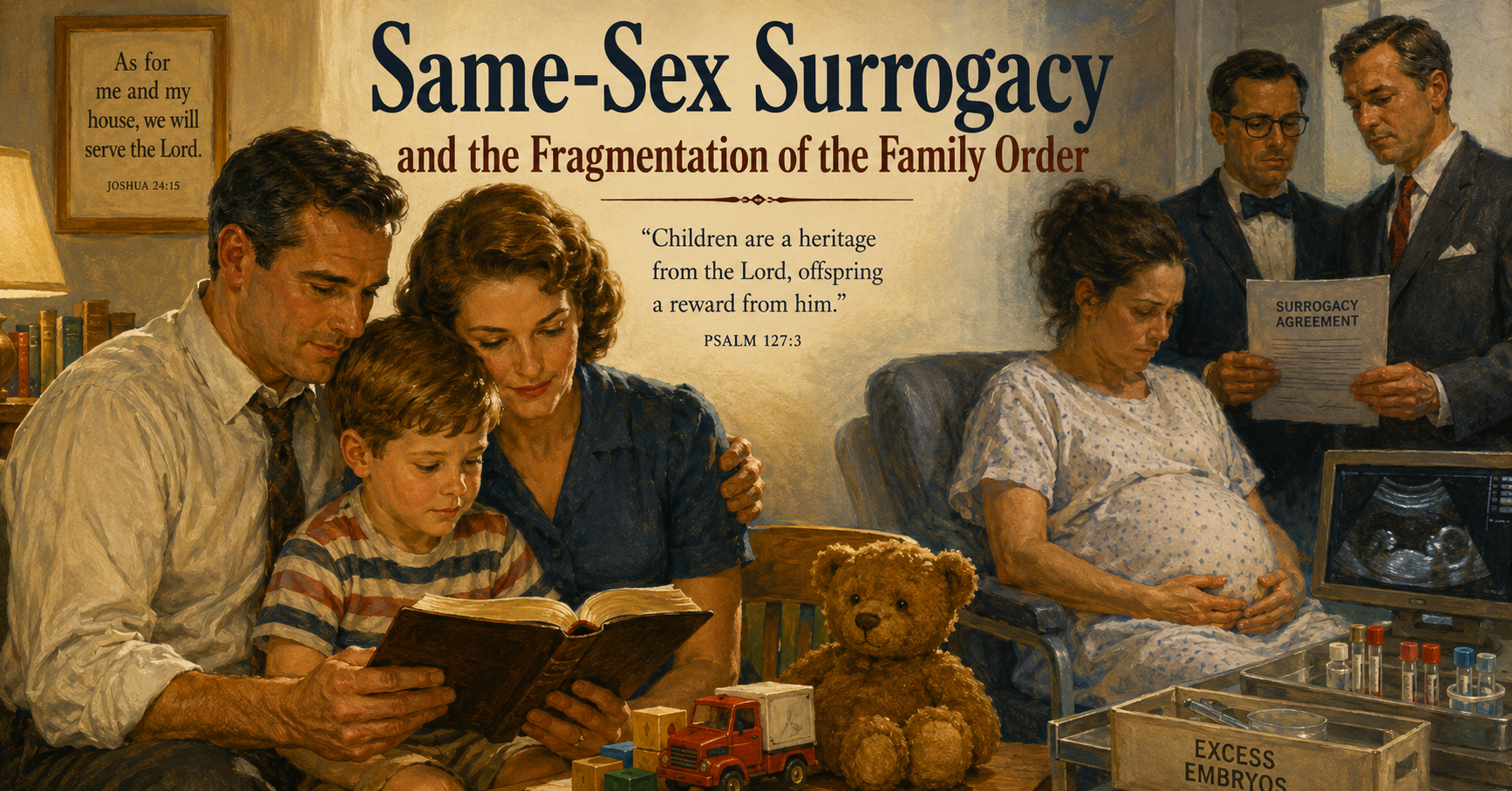
Psalm 127:3 says:
Children are a heritage from the Lord, offspring a reward from him. (NIV)
Yet Scripture never teaches that every deeply felt desire must be fulfilled by whatever means technology permits.
Human beings experience many powerful desires that must be morally governed.
Christianity has always distinguished between compassion for longing and moral approval of every method used to satisfy this longing.
Same-sex surrogacy attempts to fulfill the natural desire for parenthood through arrangements that bypass the natural reproductive design established in creation.
Technology can imitate biological outcomes, but it cannot erase the underlying reality that reproduction is naturally ordered toward male-female union.
The Child-Centered Question
Modern debates often focus almost entirely on adult happiness:
- Do the adults love the child?
- Do the adults want the child?
- Can the adults financially support the child?
These questions matter, but they are incomplete.
Christian ethics asks an additional question:
What family structure best serves the long-term flourishing of children?
Children are not merely accessories to adult fulfillment. They are image-bearers with their own rights, needs, identities, and developmental interests.
A truly child-centered ethic asks whether intentionally depriving a child of either motherhood or fatherhood serves the child’s best interests.
The Importance of Mothers and Fathers
Why Male and Female Role Models Matter
Both Scripture and human experience testify to the importance of mothers and fathers.
The Bible frequently presents fathers and mothers as possessing distinct forms of influence.
Fathers are repeatedly associated with protection, instruction, discipline, provision, and leadership. Mothers are repeatedly associated with nurture, tenderness, comfort, and formative relational care.
These categories overlap, but they are not meaningless.
Children generally benefit from observing:
- male behavior modeled responsibly,
- female behavior modeled responsibly,
- healthy interaction between the sexes,
- and complementary parental dynamics.
Same-sex surrogacy intentionally removes one of those relational models from the child’s ordinary home environment.
Identity Formation and Possible Confusion
Children naturally ask:
- Where did I come from?
- Who are my biological parents?
- Why was I separated from them?
- Why do I not have a mother or father in my home?
Surrogacy can create uniquely complex identity questions because biological, gestational, legal, and social parenthood may all involve different individuals.
For some children, this fragmentation may produce feelings of confusion, displacement, abandonment, or commodification.
Modern society often assumes children are infinitely adaptable. Yet psychological research repeatedly demonstrates that origins, biological connection, and family identity matter deeply to many people.
The Testimony of Donor-Conceived Adults
In recent years, increasing numbers of donor-conceived adults have publicly discussed feelings of alienation associated with reproductive technologies.
Some describe:
- emotional confusion,
- grief over unknown biological parents,
- resentment toward commercial conception arrangements,
- and feelings of being intentionally deprived of natural family bonds.
Not every donor-conceived individual experiences such pain. Human outcomes vary widely. Yet these testimonies should not simply be dismissed because they complicate modern narratives surrounding reproductive technology.
Christians especially should listen carefully to the voices of children and adults shaped by these systems rather than focusing exclusively on adult desires.
Preborn Life and the Moral Problems of Reproductive Technology
Embryo Creation and Destruction
Same-sex surrogacy commonly relies upon IVF procedures involving the creation of multiple embryos.
Frequently:
- multiple embryos are produced,
- only some are implanted,
- others remain frozen indefinitely,
- and some are discarded or destroyed.
From a biblical pro-life perspective, this presents an enormous moral problem.
If human life begins at conception, then embryonic destruction involves the destruction of actual human beings at their earliest developmental stage.
Psalm 139 declares:
For you created my inmost being; you knit me together in my mother’s womb. (NIV)
Likewise, Jeremiah 1:5 states:
Before I formed you in the womb I knew you. (ESV)
Historic Christianity has generally affirmed the sanctity of human life because humans bear God’s image from conception onward.
Frozen Human Life and Selective Implantation
The modern fertility industry increasingly treats embryos as manageable biological inventory:
- frozen,
- selected,
- graded,
- transferred,
- or discarded.
This mentality risks reducing human life to laboratory material.
Some IVF practices also involve “selective reduction,” in which implanted embryos are aborted to reduce multiple pregnancies.
Christians who rightly oppose abortion should think carefully about the reproductive systems that often generate large-scale embryonic destruction behind closed laboratory doors.
Exploitation, Power, and the Shadow of Slavery
Economic Exploitation in Commercial Surrogacy
Commercial surrogacy frequently involves major economic inequalities.
Wealthier commissioning parents often hire women with fewer financial resources to carry pregnancies under highly regulated contractual conditions.
In some international arrangements, impoverished women effectively rent their reproductive capacity to affluent clients from wealthier nations.
Even where consent exists, Christians must still ask whether economic desperation can distort genuine freedom.
Similarities to Historical Forms of Human Commodification
Surrogacy is obviously not identical to chattel slavery. Important distinctions exist and should be acknowledged honestly.
Yet some similarities remain troubling:
- contractual control over bodily functions,
- financial purchase arrangements,
- transfer of children through agreements,
- and treatment of reproductive labor as market commodity.
Historically, Christians opposed the reduction of human beings into commercial property because every human bears God’s image.
Surrogacy risks moving reproduction itself into a commercial marketplace governed increasingly by wealth and consumer preference.
The Problem of Contractual Parenthood
Parenthood has historically been understood as covenantal and relational. Surrogacy increasingly reframes parenthood as contractual and transactional.
This shift matters.
A society that treats children as products acquired through agreements may gradually lose the understanding that children are gifts entrusted by God rather than entitlements guaranteed by technology.
Abuse, Vulnerability, and Long-Term Social Concerns
The Relative Newness of Same-Sex Surrogacy
Same-sex surrogacy is historically recent. Long-term multigenerational data remains limited.
That reality alone should encourage humility and caution rather than sweeping declarations that no serious risks exist.
Human societies often discover the consequences of social experiments decades after widespread adoption.
Risks and Possibilities
There is currently limited large-scale long-term data specifically involving same-sex surrogacy arrangements. Therefore, claims regarding abuse rates should be approached carefully and honestly.
Christians should avoid exaggeration or unsupported accusations.
At the same time, prudential concerns remain legitimate. Any intentionally fragmented family structure may create unique vulnerabilities related to:
- identity formation,
- attachment,
- relational instability,
- emotional confusion,
- and exploitation.
Additionally, the commercial fertility industry itself creates opportunities for abuse involving:
- donor anonymity,
- legal disputes,
- reproductive coercion,
- embryo trafficking,
- and exploitation of vulnerable women.
Why Christians Should Exercise Moral Prudence
Biblical wisdom repeatedly warns against reckless social experimentation.
A culture intoxicated with technological optimism may underestimate unintended consequences.
Conservative Christian ethics generally emphasizes prudence because human nature is fallen and institutions often produce harms that are not immediately obvious.
The burden of proof should therefore rest heavily upon those radically redefining parenthood and reproduction.
Compassion, Truth, and the Christian Witness
Speaking the Truth Without Malice
Christians are commanded both to love their neighbors and to uphold God’s truth.
Ephesians 4:15 calls believers to speak “the truth in love.”
That means Christians should reject:
- cruelty,
- mockery,
- hatred,
- or dehumanization.
People experiencing same-sex attraction are image-bearers deserving dignity and compassion.
At the same time, compassion does not require moral affirmation of sinful behavior and social institutions.
Christianity has always distinguished loving persons from endorsing every moral choice.
The Church’s Responsibility
The modern church must think carefully about biotechnology, family ethics, and cultural pressures.
Too often Christians react emotionally or superficially rather than developing coherent biblical frameworks for emerging technologies.
Churches should:
- strengthen biblical marriages,
- support faithful family life,
- encourage orphan care within biblical structures,
- provide pastoral care for infertility,
- and teach believers how to think Christianly about modern reproductive technology.
Conclusion: Recovering a Biblical Vision of Family
Same-sex surrogacy represents far more than a private lifestyle choice. It reflects a profound redefinition of family, reproduction, embodiment, and parenthood.
At its core, the debate concerns whether human desire or divine design will govern human life.
Scripture consistently presents marriage as a covenantal union between man and woman ordered toward companionship, procreation, and family stability.
Same-sex surrogacy intentionally separates these realities through technological intervention and contractual arrangements.
It fragments motherhood and fatherhood.
It commercializes reproduction.
It risks commodifying children.
It frequently depends upon embryo destruction.
It intentionally deprives children of either maternal or paternal presence within the home.
And it increasingly treats biological limitations as obstacles to be technologically conquered rather than boundaries carrying moral significance.
Christians need not deny the sincerity or emotional pain of those who pursue surrogacy. Infertility, loneliness, and longing for family are deeply human experiences deserving compassion.
Yet Christianity teaches that moral truth is not determined by emotional intensity. God’s commands and created order exist for human flourishing even when obedience proves difficult.
Modern culture often views freedom as liberation from limits. Biblical Christianity instead teaches that true freedom is found within God’s design.
The church should therefore resist both cruelty and compromise:
- refusing hatred,
- refusing fear,
- but also refusing to surrender biblical truth to cultural pressure.
Children are not products.
Parenthood is not an entitlement.
Technology is not morally neutral.
And God’s created order is not arbitrary.
Recovering a biblical vision of marriage and family will require courage in an age increasingly hostile to moral boundaries. Yet Christians believe God’s design is ultimately good, wise, and life-giving.
As society continues redefining family through biotechnology and ideology, believers must continue asking an older and more important question:
Not merely, “What can modern technology accomplish?”
But rather:
“What kind of human beings, families, and societies did God intend us to become?”
The same-sex couple who desire to have children and considering surrogacy should ask themselves whether they are suppressing the natural desire to have children with a wife in a natural male-female marital relationship. Is it responsible to bring another human being into a disordered situation that reflects rebellion against God and His design for humanity?
S.D.G.,
Robert Sparkman
rob@basedchristianity.org
RELATED CONTENT
Brittney Pearson was a surrogate mother on two occasions. Allie Beth Stuckey interviews her about the clients, two homosexual men, who insisted she have an abortion after encountering problems with her health during the pregnancy.
Allie Beth Stuckey has several videos on surrogacy that are well worth the viewing. She always has thoughtful content from a Christian perspective.
Concerning the Related Content section, I encourage everyone to evaluate the content carefully.
I will continue to add videos and other items to the Related Content section as opportunities present themselves.If I have listed the content, I think it is worthwhile viewing to educate yourself on the topic, but it may contain some opinions I don’t agree with.
Feel free to offer your comments below. Respectful comments without expletives and personal attacks will be posted and I will respond to them.
Comments are closed after sixty days due to spamming issues from internet bots.
You can always send me an email at rob@basedchristianity.org if you want to comment on something afterwards, though.
If you have evidence that I am wrong about a material statement of fact, provide the evidence and I will gladly review it and make revisions if merited.
Obviously, there are some assertions that are matters of opinion that I will not change, but I always strive to be truthful. We are all capable of mistakes and misunderstandings on occasion, though.
Regarding depictions of Jesus, images accompanying the article may contain depictions of Jesus.
I realize that some fellow Christians, particularly some conservative Presbyterians, consider these images to be a form of idolatry. I do not agree with their opinion on this matter. The Second Commandment forbids worship of idols. These images are for illustrative purposes and do not represent a form of worship.
I recommend these Youtube channels for good content on Christian matters: Founders Ministries, Ligonier Ministries, Grace to You, G3 Ministries, and Truth for Life. RC Sproul, Voddie Baucham, Alistair Begg, Kevin DeYoung, Albert Mohler, Tom Ascol and John MacArthur are well-known, trustworthy pastors and teachers with content across multiple forums.
Albert Mohler, Francis Schaeffer, Allie Beth Stuckey and Nancy Pearcey have some valuable materials related to cultural matters, as well.